
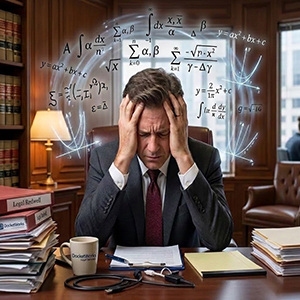
Something my husband always tells people that immediately makes me cringe is, “She’s so good at math!” NO, dear, no I am not. I can do basic algebra and eighth-grade-level numbers, but struggle with anything more advanced. A parabolic function? What in the heck is that? Calculus? Might as well be Linear A; I have no idea.
But because I’m educated and can read and write, my husband assumes that I’m excellent at math, too. In reality, 80% of the time, I’m pulling out my phone’s calculator for even basic tasks.
So what is the connection between law and numbers, and what does a healthy connection look like? Let’s unravel some myths, get down to the reality of the math-law link, and pave a workable path forward.
So, are lawyers naturally geared towards mathematics? A client may crudely joke that you must be great at math based on the bills they’re receiving, but most clients don’t understand the years of study and weighing your skills and strengths that went into a law school decision.
What were you good at? What did you want to do? What interested you? For attorneys who gravitated towards law due to a genuine interest in justice and advocacy, it was likely principles rather than numbers that drove their studies. For lawyers pursuing a degree to please their parents, stability, general success, and respectability may have been the main motivator.
Neither of these elements has much of anything to do with math. And as many attorneys focus on the humanities in college, most of you (and myself) may very well have left math behind in high school. Save for one incredibly disastrous “Symbolic Logic” class where the professor declined to fail me out of pity.
We use numbers to tally a tip, but the day-to-day work that you do focuses more on arguments, evidence, and the nuances of how a prosecutor or a jury will see that evidence. Variables abound. Winning for a client may not be strictly about a 0.09% BAC number, for example, but about how well you can convince a judge that the police overstepped their bounds leading up to the arrest, negating probable cause.
This isn’t a matter of strict mathematics, but of persuasion, seeing your client’s arrest and case from all angles, knowledge of the law, and an interest in justice and a better future for the person you’re representing. None of this involves a calculator.
Now, while you’re not going to be bringing y = a x2 + b x + c into the courtroom, there are moments when numbers are truly helpful, and on your side. For example, a certain use of numbers can help lean a jury toward your main point.
For example, a prosecutor may say that there is a 1 in 1,000 chance that the partial DNA sample found at a crime scene is from someone other than your client. Those sound like terrible odds and are known as the “prosecutor’s fallacy”.
But if you live in a large metropolitan area, you could also explain to a jury that there are 1,300 other people in your city who could also be a match for this DNA.
While the prosecution is likely to emphasize the 1 in 1,000,000 figure, you’ll need to focus on the 1,300 figure. Both explanations use numbers, juries tend to appreciate certainty and statistics, and your legal push for more information could help see your client declared “not guilty”.
In these instances, numbers, and how numbers are expressed, can be critical to winning a case. Not only because of mathematics, but because of how juries understand figures, data, probability, and evidence. But as you can see, there’s more at work here than just mathematics. There’s evidence, motive, psychology, connections between a suspect the police missed and the victim, and helping a jury “reasonably doubt” the prosecution’s evidence.
The conclusion: while numbers can be helpful in specific cases, much of your legal work revolves more around evidence, jury impressions, and seeking out the details and data that could win a case. What does this mean for you? Simply that there’s absolutely no shame in being a fantastic lawyer who struggles with their teenager’s trigonometry homework. Because that is not where your skill set, or your grasp of logic, needs to be centered.
You use software and calculators to crunch the numbers on billing, and you know what? That’s absolutely fine, so do I. And the good news is, there is help available for talented, rational, and skilled attorneys who still struggle with figures, decimals, and 1099-NEC forms.
And this is part of what we do at DocketWorks. You’re logical, smart, and driven, and not every master sculptor knows how to code an LLM or build a schooner. You have a skill set that is all your own, you’ve worked hard to develop that skill set, and you should be deeply proud.
In the meantime, your ILA can help you handle billing, payment tracking, spreadsheets, and more. Next, we handle payroll and taxes. You pay us a flat, simple rate, and we manage the numbers. You don’t have to turn into a total payroll department or manage your ILA’s W-2s. That’s all handled by us, leaving you free to delegate tasks without fear.
Your ILA comes fully trained within weeks and can help you with intake, document drafting, e-filing, file organization, billing, and more. The only thing they won’t do is advise or represent your clients. You save 10 to 40 hours per week, get your life back, and can advocate for clients with even greater mental clarity and mental bandwidth.
Looking to hire support, but unsure where to begin, how to handle payroll, or how to afford a paralegal’s salary? Let DocketWorks help.
Our ILAs are fellow attorneys, accredited, and strictly vetted, and their services come in at half the rate of an experienced, US-based paralegal. This means more efficiency and fewer mathematical headaches for you and your firm.
To see what this would look like? Schedule a Discovery Call with Parke Parker today. There’s no pressure, just answers, help, and a clear path forward. Minus the fractals.

Grace Singh is a writer and editor for DocketWorks. She enjoys bridging services and client needs in ways that are meaningful, memorable, and human-focused, even as technology continues to change. When she’s not at her home office, she enjoys nature walks, reading, and brewing coffee.